Parathyroid Gland Surgery
The main reason people are refered for parathyroid surgery (or parathyridectomy) is hyperparathyroidism. Hyperparathyroidism is classified into three types: primary, secondary, and tertiary. By far, the most common of these is primary hyperparathyroidism. In this condition, an abnormal parathyroid gland (parathyroid adenoma) is releasing too much parathyroid hormone into the blood. This extra parathyroid hormone robs the bones of calcium and causes extremely high levels of calcium into the blood. This can lead to many problems including weakening of bones and calcium accumulation in the urinary system cusing kidney stones. Parathyroid surgery can eliminagte all these problems by identifying and removing the abnormal gland. This page is intended to provide some general information about parathyroid surgery, with specific attention to minimally invasive parathyroidectomy techniques.
Anatomy: The parathyroid glands are located behind the thyroid gland in the central neck just below the larynx (or voice box). Usually, there are two on each side giving most people a total of four small glands.
Minimally Invasive Parathyroid Surgery: The goal of minimally invasive parathyroid surgery is to remove an abnormal parathyroid gland (or glands) through the smallest possible incision. Because the central neck contains many important structures, this must be done in the safest, least traumatic manner possible. The structure most commonly encountered is the recurrent laryngeal nerve (RLN), which moves the vocal cords. Meticulous dissection is essential to ensure that this nerve is not damaged so that problems with speech and swallowing don't occur. Here are some guidelines and thinking points in considering minimally invasive parathyroidectomy.
The Incision: Naturally, this is the first thing that comes to mind when considering minimally invasive parathyroid surgery. Generally, a 1 inch incision (2 to 3 centimeters) is adequate to explore one side of the neck and remove a parathyroid adenoma. Describing the incision length in inches isn’t really applicable to minimally invasive parathyroid surgery. For example, if you’re told that the incision will be 1 to 2 inches, you may wake up with a 5.0 cm incision. This is quite long and doesn’t really fit the current understanding of minimally invasive parathyroid surgery. Therefore, it’s appropriate to ask your surgeon if the incision will be closer to 1 inch or 2 inches in length. If you want to be more exact, ask about the length in centimeters. Also, seeing some examples of postoperative scars in the surgeon’s picture gallery is a good way to get an idea of what to expect.
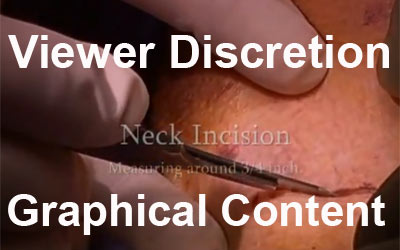
The link below is of a minimally invasive parathyroidectomy performed under local anesthesia. It is provided for those who are interested in the specific details of the operation. PLEASE NOTE THAT CONTENT IS VERY GRAPHIC AND NOT FOR THE SENSITIVE VIEWER.
A note about postoperative pictures: If you end up comparing picture galleries, make sure that multiple skin types and age groups are represented. That’s important because younger, smoother skin makes hiding an incision more difficult. As we mature, skin laxity and natural tension lines (wrinkles) develop which make hiding even relatively large incision quite easy. When evaluating pictures, you want to make sure to see at least a few examples of incisions in younger individuals because these are more difficult to hide and will give you a better sense of the technique and results. Feel free to visit Dr. Amini’s picture gallery to see some examples of minimally invasive thyroid surgery performed through incisions just under 1 inch. We have taken care to include pictures of people in all age groups.
The Anesthesia: Minimally invasive doesn’t just apply to incision size. The overall experience should be less traumatic to your body as a whole. If your pre-surgical workup has identified which side the abnormal parathyroid is on, the surgeon should be able to offer you the procedure under local anesthesia with intravenous sedation. This is especially important if you have a heart condition or other medical conditions that can make general anesthesia more dangerous for you. But even if you are perfectly healthy, you may want to avoid the added risk of general anesthesia if you can. Keep in mind, however, that the procedure is called an “exploration” for a reason. For some people, both sides of the neck need to be explored and that will require general anesthesia. Most of Dr. Amini’s patients chose to start their parathyroid surgery under local anesthesia with sedation. In such cases, medicine given through the veins gently induces a comfortable sleep after which the local anesthetic is given. The surgery is then performed while the patient sleeps, breathing on their own, without a tube going to the lungs.
The Technology: While a common goal of minimally invasive surgery is to keep incisions small and local trauma to a minimum, the most important goal is to remove the diseased gland while keeping vital structures intact. The recurrent laryngeal nerve (RLN), which is responsible for movement of the vocal cords, lies very close to the parathyroids. Make sure your surgeon is comfortable identifying and preserving the RLN as this may become necessary if the abnormal parathyroid gland proves difficult to find and more extensive dissection is needed. If this is your second time undergoing a neck exploration, you will need to have the procedure done very carefully under general anesthesia. In such cases, the surgeon may chose to utilize a RLN monitor. This new technology allows for careful monitoring of the RLN and reduces the chance of accidental injury to it. Dr. Amini routinely uses the RLN monitor in difficult full neck explorations and revision cases. Another advancement that you should be able to take advantage of is the PTH assay. PTH is the hormone produced by the parathyroid gland. High PTH levels are the main cause of problems in people with hyperparathyroidism that need parathyroid surgery. The PTH assay allows the surgeon to know what the PTH level is once the abnormal gland is removed. This way, in the rare case that there is more than one abnormal parathyroid, the search can continue while the patient is still asleep, thus avoiding repeated trips to the operating room.
|
Dr. K. Amini 8435 Reseda Blvd Northridge, CA 91324 |



@ ENT Doctor LA, Website was created and maintained by Biago Media