Head and Neck Surgery // Submandibular Gland Surgery
The submandibular glands are major salivary glands located in the upper neck, just under the jaw. They produce saliva which is released from two small ducts on the floor of the mouth in front of the tongue. Deep to the submandibular gland run two important cranial nerves. One, the lingual nerve, provides sensation to the tongue and oral lining. The other, called the hypoglossal nerve, is responsible for movement of the tongue. The two major categories of diseases that affect the submandibular gland are infections and tumors.
Submandibular gland infections (called sialoadenitis) are usually caused by blockage of the drainage system of the gland. This can be due to salivary stones that block the drainage pathway or to dehydration which makes it more difficult for the gland to empty the saliva it has produced. Fortunately, the majority of infections can be successfully treated medically without need for surgery. In some cases, stones can be extracted by dilating the duct and removing the stone in the office. In rare cases, however, chronic infections may lead to a recommendation of surgery tro remove the entire gland.
Submandibular gland tumors can be benign or malignant. In most cases, work up will include imaging (such as CT or MRI) and needle biopsy to try and determine the nature of the mass. Most tumors of the submandibular gland will require surgery, which almost alway involves removing the entire gland. During operation, it is critical that the lingual and hypoglossal nerves are identified and preserved, so that taste, sensation, tongue mobility and speech are not affected.
In the case of known cancer (or if cancer is diagnosed during the operation), there may be need to perform a neck dissection. This procedure aims to remove all lymph nodes and soft tissue structures that the cancer may have spread to in the neck. Neck dissection demands extreme technical skill. Many critical nerves, arteries and veins have to be identifien and saved as the surrounding nodes, glands and soft tissues are removed. Therefore, it is important that the surgeon have enough experience and expertise to offer and perform this operation if it becomes necessary.
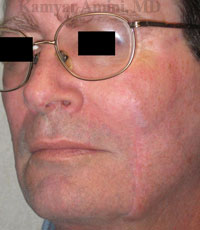
Dr. Amini has significant experience with submandibuar gland excision. His experience in facial plastic and reconstructive surgery is extremely useful in ensuring the best possible cosmetic outcome with the least amount of scarring afterwards. Finally, because Dr. Amini is routinely involved in the surgical treatment of other head and neck cancers, if more radical resection or neck dissection is necessary, you can rest assured that these will be performed with the the same high level of technical skill and expertise.
|
Dr. K. Amini 8435 Reseda Blvd Northridge, CA 91324 |


@ ENT Doctor LA, Website was created and maintained by Biago Media