Oral Cavity / Larynx / Pharynx
The oral cavity, pharynx and larynx are the medical terms that define the mouth, throat and voice box. The structures  involved include everything from the lips back to the throat and all the way down to the voice box. Given the large number of structures and the many diseases that affect these areas, a detailed discussion of all sites is well beyond the intended scope of this section. Therefore, we will try to provide some general information about anatomy, symptoms, and common disorders.
Oral Cavity - Anatomy: Most of the structures you can easily see when looking at your mouth in the mirror are part of the oral cavity. These include the lips, gums, hard palate, tongue, floor of mouth, and inner surface of the cheeks.
Pathology - Problems that affect the oral cavity can be broadly divided into infections, tumors, and immune related diseases.
Infections can be viral or bacteria and can manifest as common conditions such as gingivitis or cold sores (which are caused by the herpes virus). In many cases, simple observation or antibiotics will be recommended. This process should not last more that a few weeks. Therefore, if any lesion diagnosed as an infection lasts longer that a few weeks, evaluation by a head and neck surgeon should be considered because a biopsy will likely be necessary.
Benign Tumors of the oral cavity can be either benign or malignant. 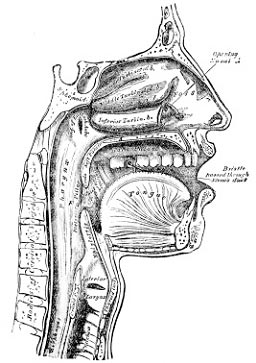 Examples of benign tumors include irritation fibromas and mucoceles. Irritation fibromas are benign growths that usually result from local trauma. Mucoceles are sacs filled with mucous. They usually result when a blocked salivary gland cannot empty itself and just fills up with saliva. Simple surgical excision is usually enough to resolve these issues.
Oral Cancer is, of course, a much more serious condition. Like other types of cancer in the upper airway and digestive tract, tobacco and alcohol abuse are significant risk factors. Lesions often times start off as patches or white or red plaques (called leukoplakia or erythroplakia) that are considered "pre-cancers". With time and continued irritation, these lesions can transform into true malignant cancer lesions. Malignant lesions are often painful, ulcerated, and sometimes bleed. However, these signs are not necessarily present with all cancers. What is universal among oral cancer, however, is that the lesion will not shrink or resolve with time, but rather grow. That's why any suspicious mass or lesion needs immediate biopsy if it does not resolve within a few weeks. Treatment for oral cancer will usually involve surgical excision of the mass with or without a neck dissection to remove any suspected lymph nodes. For more advanced cases, additional therapy in the form of radiation and chemotherapy will be recommended. These are the reasons that immediate biopsy is necessary when a suspicious mass is present. The earlier you diagnose an oral cancer, the less aggressive the treatment and the better the chance for cure.
Immune related lesions include all lesions that are somehow associated with an overly aggressive immune response. Basically, the body attacks itself and causes various lesions that are neither infections or cancerous. Some believe that the common canker sore is immune related. Immune related lesions may respond to steroids or various injections. Often times, referral to a rheumatologist may be necessary.
Treatment - Treatment for oral lesions obviously depends on what the cause is. Infections will often require antibiotic treatment. Some viral infections, like the common herpetic ulcer or cold sore, will simple be observed and resolve with time. Immune related lesions may respond to steroids or various injections. Often times, referral to a rheumatologist may be necessary. Treatment for oral cancer will usually involve surgical excision of the mass with or without a neck dissection to remove any suspected lymph nodes. For more advanced cases, additional therapy in the form of radiation and chemotherapy will be recommended. These are the reasons that immediate biopsy is necessary when a suspicious mass is present. The earlier you diagnose an oral cancer, the less aggressive the treatment and the better the chance for cure.
|
Dr. K. Amini 8435 Reseda Blvd Northridge, CA 91324 |



@ ENT Doctor LA, Website was created and maintained by Biago Media