Ear Infections
Ear infections are categorized based on their location with respect to the ear drum.
Otitis externa describes infections of the skin of the ear canal up to and including the ear drum. Basically the "external" canal skin is infected causing swelling, redness, and significant pain. "Swimmers ear" is the term commonly used to describe otitis externa since exposure to water is one of the main causes of this problem. Treatment involves topical antibiotic drops and keeping the ear dry. Keep in mind that both bacteria and fungus can cause this problem so if treatment isn't working, you may be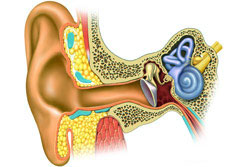 treating the wrong bug. While this type of infection is usually cured quickly and easily, some people (such as diabetics) may be much more difficult to treat and cure. Any "swimmers ear" that hasn't gotter better within 2 to 3 weeks of appropriate therapy should be evaluated by and ENT physician.
Otitis media describes infections of the space behind the ear drum. To be exact, the term otitis mecia is used to describe inflammation, swelling, and fluid buildup in the middle ear space from any cause. In the illustration to the right, you can see that there is a small space (colored red) behind the eardrum. This is the middle ear space and it contains the three bones of sound conduction (ossicles, colored bone yellow) on top and the tube that connects the ear to the throat (eustachian tube, colored in red) opening on the bottom. Infections, anatomical problems and allergies can prevent fluid in the middle ear from draining into the throat. This will lead to inflammation and fluid buildup in the middle ear space resulting in pain, hearing loss, and possibly rupture of the ear drum with drainage of infected fluid.
It's important to treat this problem early in order to avoid fever, pain, complicated and dangerous infections, and prolonged hearing loss which can limit learning. Treatment begins with medicine to control pain and antibiotics to cure the infection. Usually, this will cure the infection and swelling, allowing the fluid to drain normally.
Surgery for otitis media is reserved for either recurrent or chronic disease. Sometimes, the fluid behind the eardrum will not drain, even if the infection is cured. In other cases, the infection may come back over and over requiring multiple courses of antibiotics throughout the year. In these situation, an operation called tympanostomy may be needed. This is where an incision is made in the eardrum after which a very small tube is placed to help drain the fluid.
Because the types of ear infection vary and because there are several different treatment options, evaluation by an ENT doctor early on can help direct therapy for otitis media so that complications and chronic problems are avoided.
|
Dr. K. Amini 8435 Reseda Blvd Northridge, CA 91324 |


@ ENT Doctor LA, Website was created and maintained by Biago Media